
We must kill NET ZERO before it kills us!
by Mary-Jean Harris

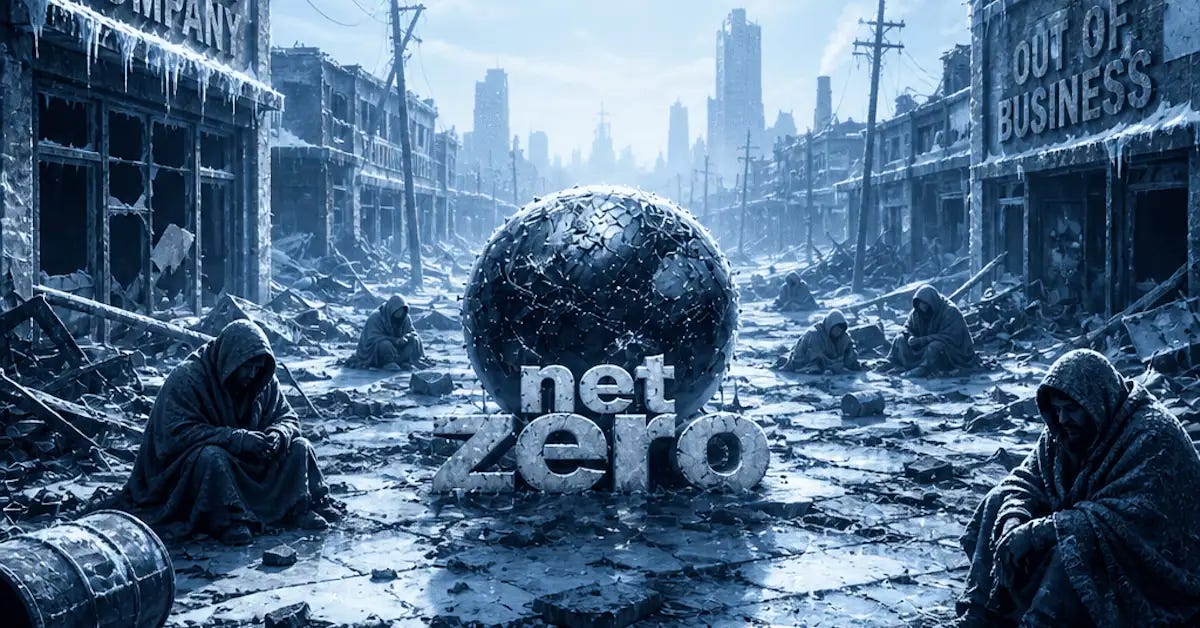
Physicist Maria-Jean Harris reviews four chapters from Canary in a Climate World: Climate Realism vs. the Net Zero Myth, featuring contributions from Greenpeace co-founder Dr. Patrick Moore, Professor Ian Clark, economist Robert Lyman and Dr. John Christy. (Originally published on America Out Loud News.)
Net zero is the worldwide goal to reduce carbon dioxide and other greenhouse gas emissions, the latest, and perhaps most comprehensive scheme by climate alarmists to overhaul our modern way of life. Yet many experts warn us about the dangerous consequences of net zero, and today, we will highlight the work of some of these scientists and economists to give you the facts you need when up against those promoting the net zero and climate alarmist narrative.
Net zero insists that we rapidly eliminate fossil fuels, replacing them with so-called “renewable” energy such as wind and solar by 2050. The goal is to have our carbon dioxide (CO2) emissions balance measures that draw CO2 out of the air, hence the “zero” in net zero, meaning that we will cause no net increase of CO2 in the atmosphere.
Professor William A. van Wijngaarden of the Physics Department at York University in Toronto explained in his June 2026 presentation,
“Net zero efforts to outlaw fossil fuels, reduce cattle numbers and fertilizer use, endanger the food supply and make it impossible to preserve the standard of living and, most significantly, are not supported by scientific evidence!”
Dr. van Wijngaarden shows how even doubling the concentration of CO2 in the atmosphere would amount to only about 1°C of warming, and that observational evidence does not support hysteria about glacier retreat, sea level rise, and increases in extreme weather. Net zero policies will cause serious damage to our society with no benefit, and we would be foolish to lead our country to ruin for no benefit.
The newly released book, Canary in a Climate World: Climate Realism vs. the Net zero Myth, highlights essays from 38 experts about the science of climate change and the fallacies of net zero as well.
In ecologist Dr. Patrick Moore’s Canaries essay, he explains that wind and solar are intermittent sources of energy that need to be supported by backup systems and storage technologies, both of which can be expensive and, of course, use fossil fuels. We would do better to turn to nuclear power, which, Dr. Moore writes, “remains one of the safest large-scale energy technologies ever developed.” Nuclear power can produce enormous amounts of electricity with small quantities of fuel and minimal land use, unlike the vast stretches of land required for wind turbines and solar panels. What net zero proposes, namely, turning all our energy to renewables, is entirely unsustainable with our current level of technology.
Professor Ian Clark is an environmental geoscientist from the University of Ottawa in Canada. In his Canaries essay, he explains that net zero is simply impossible. Moreover, the materials required for renewable energy production need oil and gas to produce the vast infrastructure for “green” energy. The graph below illustrates the materials needed for green energy production. Compared to nuclear, they require massive amounts of materials. Dr. Clark also points out that for a country like Canada, which has four nuclear stations, to make a realistic contribution to net zero, it would need fifty new nuclear stations, which is simply not economically feasible today.
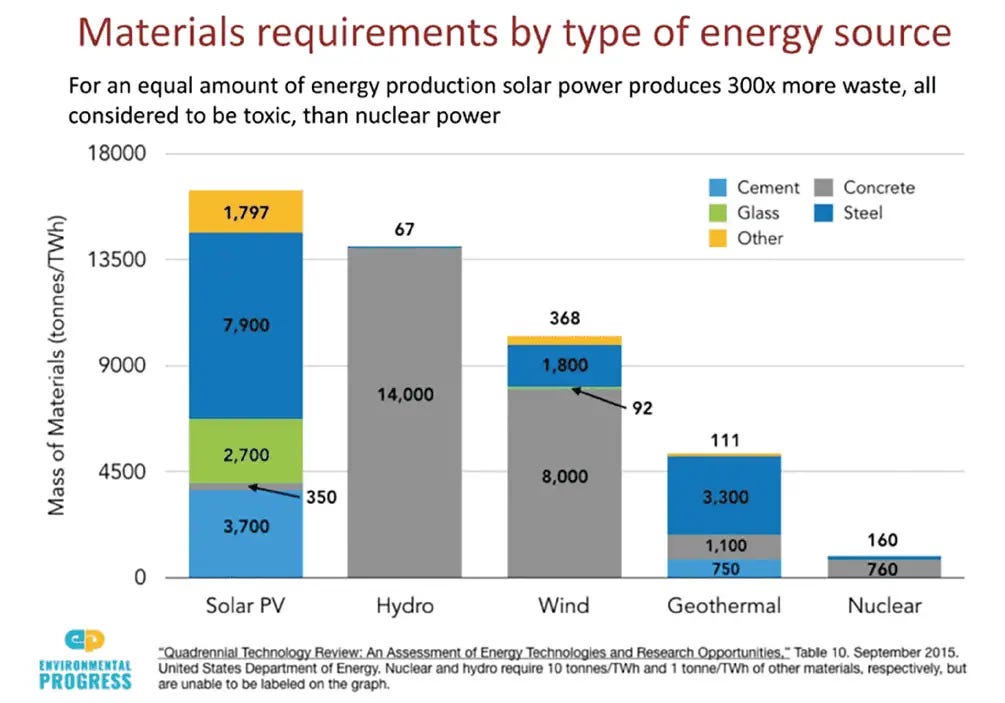
Materials required to produce power for different energy sources
(Canary in a Climate World: Climate Realism vs. the Net zero Myth, p. 111)
Another absurd proposal to reach net zero is “carbon capture and storage,” taking CO2out of the exhaust from gas and coal-powered plants to pump it underground. Direct Air Capture is a similar scheme, where outside air is drawn through ventilators to remove the CO2 and force it underground. These projects are extremely expensive: an Alberta company, Deep Sky, has investors betting almost $4 billion on a project to remove about 3 megatons of CO2. Yet the atmosphere contains about 875 Gigatons of CO2, which means that this project will reduce atmospheric CO2 by about 0.0003%. Even if this was not laughably minuscule, there is no point to it: CO2 is an essential gas for plant photosynthesis, and, as NASA’s video “Rising CO2 Levels Greening Earth” demonstrates, our modest contribution has been greening the planet rather than causing a climate catastrophe.
In his Canaries essay, economist Robert Lyman writes that in Canada, the federal government estimates that $3.4 – $3.8 trillion will be spent to achieve net zero by 2050. This is far more than Canada’s current GDP. He concludes:
“the implementation of the present and planned measures to reduce emissions will have so many adverse impacts on Canadians’ lives that attaining the net zero will eventually become impossible.”
With far-reaching regulations and taxation coming into full force in Canada, building pipelines will become prohibitive, and even gas-only internal combustion-driven cars will not be able to be sold by 2035 because federal regulations require 100% of new light-duty vehicle sales to be zero-emission by that year. The electricity sector in most provinces has regulations to ban hydrocarbon use by 2035 as well. This nightmare situation will impoverish the country and reduce, if not entirely destroy, Canada’s industrial competitiveness.
Why are governments so certain about their predictions of climate doom? Much of it comes from computer models. Yet the climate is a complex system that we are only beginning to understand. Moreover, when compared to reality, climate models have failed in their predictions thus far.
Dr. John Christy, climate scientist and a lead author and contributor for multiple IPCC reports, explains in his Canaries essay that:
“The average model trend fails to represent the actual trend of the past 38 years by a highly significant amount…the models are simply too sensitive to the extra GHGs [greenhouse gases] to both the model and the real world.”
This can be seen in the following graph, where the predicted temperature change for an average of 102 climate model simulations is shown in red compared to observationsfrom various sources in blue, green, and purple. Clearly, our models are nowhere near sophisticated enough to properly model future climate change. So why are we bankrupting our economies on theories that are so uncertain and that numerous scientists have been telling us are incorrect?
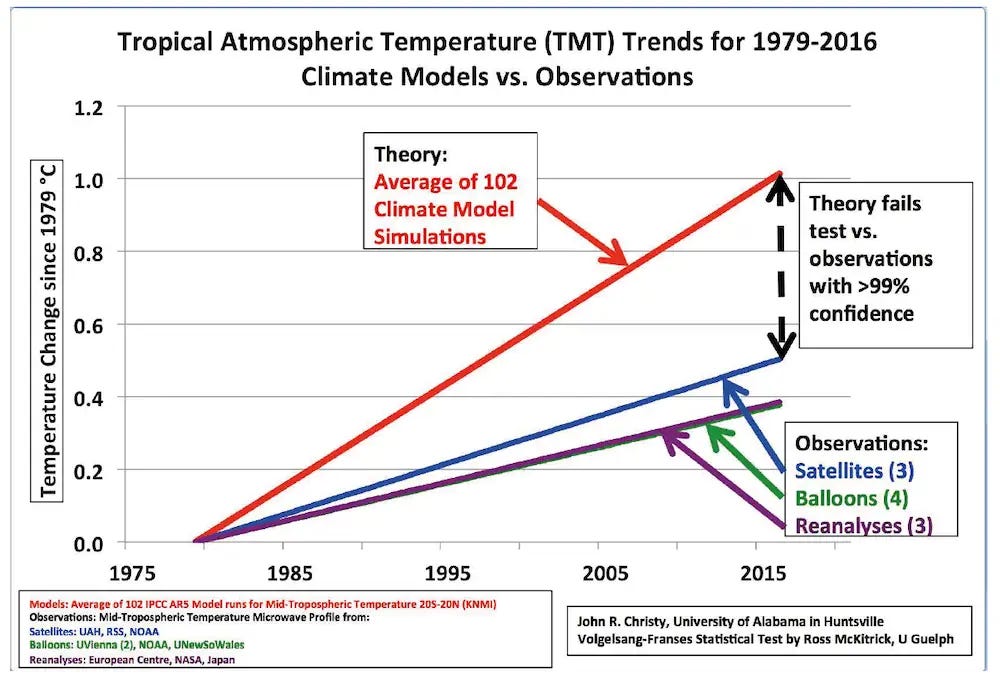
The average temperature change predicted by climate models compared to observations
(Canary in a Climate World: Climate Realism vs. the Net zero Myth, p. 142)
Net zero is harming not just us, but the environment as well, with more mining, concrete, and fields cleared to grow biofuels and house solar panels and wind turbines. It is being implemented without just cause, and we, the citizens, never consented to this bureaucratic overhaul of society.
Worldwide, over $16 trillion USD has been spent on attempts to moderate the climate, with much more planned for the coming decades. Now is the time to speak up against these destructive plans, or our prosperity will become a thing of the past!

I have no way of knowing which side of the argument is indeed correct. But I have a question: how come that during the height of Covid when airports were closed, there were suddenly clear skies above big, normally heavily polluted cities?
Another question: if nuclear energy is so safe, what about those instances when accidents happened and large areas were seriously contaminated? How to prevent such accidents from ever happening?